


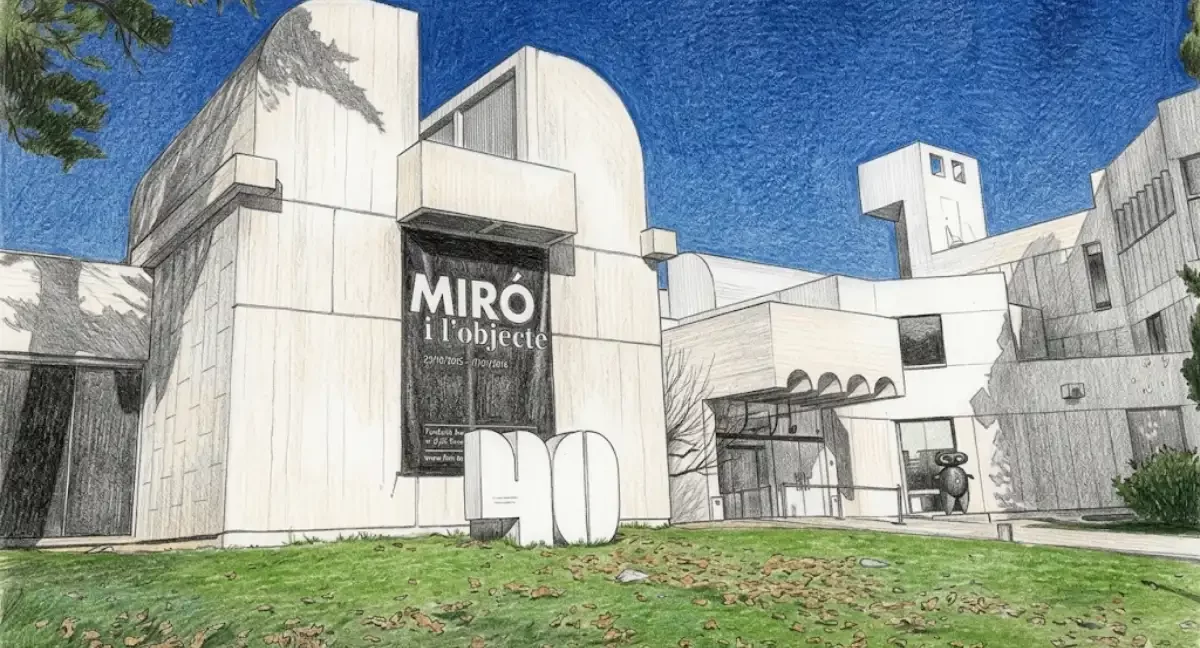
The Fundació Joan Miró is the museum dedicated to the Catalan artist on the hill of Montjuïc, home to the world’s largest public collection of his work: over 14,000 pieces. It occupies a bright Rationalist building designed by his friend, architect Josep Lluís Sert, which is itself a work of art. General admission costs €17 (online; €18 on-site), reduced €11, and under-12s enter free. It opens Tuesday to Sunday (closed Mondays). You get there on buses 55 and 150 or the Montjuïc cable car.
Other museums in Barcelona…
- Museu Picasso Barcelona
- MNAC Barcelona
- MACBA Barcelona
- MEAM Barcelona
- Museo Marítimo Barcelona
- CosmoCaixa Barcelona
- CaixaForum Barcelona
- Fundació Antoni Tàpies Barcelona
- MUHBA Barcelona

What is the Fundació Joan Miró?
High up on Montjuïc, surrounded by gardens and with views over Barcelona and the Mediterranean, sits the Fundació Joan Miró: the museum the artist himself wanted to create to bring contemporary art closer to everyone. It’s not only the largest collection of his work: it’s also one of the most admired museum buildings in the world, a place where art and architecture dialogue with the Mediterranean light. An essential visit for understanding the most universal artist of Catalan surrealism and, along the way, enjoying one of the most serene viewpoints in the city.
History of the Fundació Joan Miró
The Fundació was born from a friendship and a shared idea. Joan Miró wanted to create in Barcelona a living centre of contemporary art, open to all, and entrusted the project to his friend, architect Josep Lluís Sert, one of the great figures of 20th-century architecture. The two had already worked together on Miró’s studio in Mallorca and on the Maeght Foundation in the south of France. The museum opened in 1975 and was extended with a new wing in 1988. Today it holds the largest public collection of Miró’s work —over 14,000 pieces, mostly from the artist himself and those close to him— and is one of the most important modern art museums in Barcelona.
The building by Josep Lluís Sert
The building is an essential part of the visit. Sert designed a Rationalist complex of white walls, skylights, patios, terraces and green spaces conceived so that natural light and the landscape became part of the experience. Curves and straight lines, quiet corners and views of the park and the city: Miró and Sert designed a route with rest areas where you can pause and contemplate. The result is one of the finest examples of museum architecture in the world and a building that is as enjoyable as the works it houses.
What to see at the Fundació Joan Miró?
The Miró collection
The route lets you follow the artist’s evolution from his earliest drawings in the early 20th century to the large paintings of his final period. The collection brings together around 217 paintings, 178 sculptures, nearly 8,000 drawings and numerous textile and ceramic pieces, plus his graphic work. It’s the ideal place to understand Miró’s universe: his recognisable forms, primary colours, and the stars, birds and women that populate his poetic language.
Alexander Calder’s Mercury Fountain
One of the most singular pieces isn’t by Miró: it’s the Mercury Fountain by Alexander Calder, a friend of the artist. Created for the Spanish Republic’s pavilion at the 1937 Paris Exhibition —where it was shown alongside Picasso’s Guernica— as a protest against the bombing of the mining town of Almadén during the Civil War, the fountain pours mercury instead of water and is one of the most historically charged installations of its era.
The terraces, temporary exhibitions and views
The open-air terraces, designed by Sert, display large sculptures and offer panoramic views of Barcelona. The Fundació also programmes major temporary exhibitions of contemporary art and awards the Joan Miró Prize, keeping it a living centre rather than just a historic collection. Miró also added works by friends and contemporaries to the collection.
What are the Fundació Joan Miró opening hours in 2026?
| Season | Days | Hours |
|---|---|---|
| November – March | Tuesday to Sunday | 10:00 – 19:00 |
| April – October | Tuesday to Saturday | 10:00 – 20:00 |
| April – October | Sundays | 10:00 – 19:00 |
| Monday | — | Closed (except some holidays) |
How much does it cost to enter the Fundació Joan Miró in 2026?
| Ticket type | Price (2026) |
|---|---|
| General admission (online) | €17 |
| General admission (on-site) | €18 |
| Reduced (13-25, 65+, Barcelona Libraries Card) | €11 |
| Under 12s | Free |
| Unemployed, ICOM, Friends of the Fundació | Free |
💡 Buying online is slightly cheaper than on-site (€17 vs €18) and skips the queue. If you want to see several museums, the Articket BCN includes the Fundació alongside the Picasso Museum, the MNAC, the MACBA, the Tàpies Foundation and the CCCB.
How to get to the Fundació Joan Miró?
The Fundació is in the Parc de Montjuïc, on the slopes of the hill.
| Transport | Line / Detail | Stop |
|---|---|---|
| Bus | Lines 55 and 150 (Parc de Montjuïc) | Fundació Joan Miró |
| Bus Turístic | Red Route | Fundació Joan Miró |
| Metro + funicular | L2/L3 Paral·lel + Montjuïc Funicular | Parc de Montjuïc, then on foot |
| Cable car | Telefèric de Montjuïc | Nearby stop |
From the centre, the most practical combination is usually the metro to Paral·lel (L2/L3) and then the Montjuïc Funicular, or the 150 bus, which runs past the main points on the hill. It’s worth checking the funicular’s status before you go, as alternative services sometimes run.
Practical tips for your visit
- Buy your ticket online: it’s slightly cheaper and skips the ticket queue.
- Allow 1.5 to 2 hours for the collection, plus extra time if there’s a temporary exhibition.
- Don’t miss the terraces: the open-air sculptures and the views of Barcelona are part of the experience.
- Combine your visit with other Montjuïc must-sees: the Poble Espanyol, the Magic Fountain, the MNAC or Montjuïc Castle.
- The building has rest areas designed by Sert and Miró: use them to take in the art at a relaxed pace.
- The shop, bookshop and restaurant are free to access, with no ticket needed.
What to see near the Fundació Joan Miró on Montjuïc
| Place | Why visit |
|---|---|
| MNAC | The world’s finest Romanesque art collection, a few minutes away |
| Poble Espanyol | Open-air museum with 117 buildings from across Spain |
| Magic Fountain of Montjuïc | Water, light and music show (in season) |
| Montjuïc Castle | 17th-century fortress with sea views |
| Montjuïc gardens | Several themed gardens for a stroll |
Hotel Arc La Rambla, your base for Montjuïc and the Miró Foundation
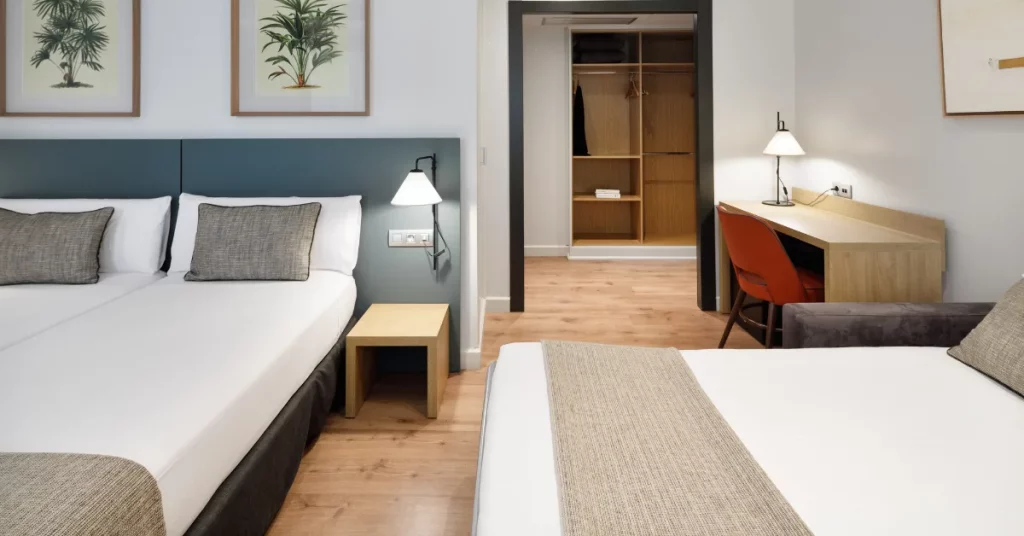
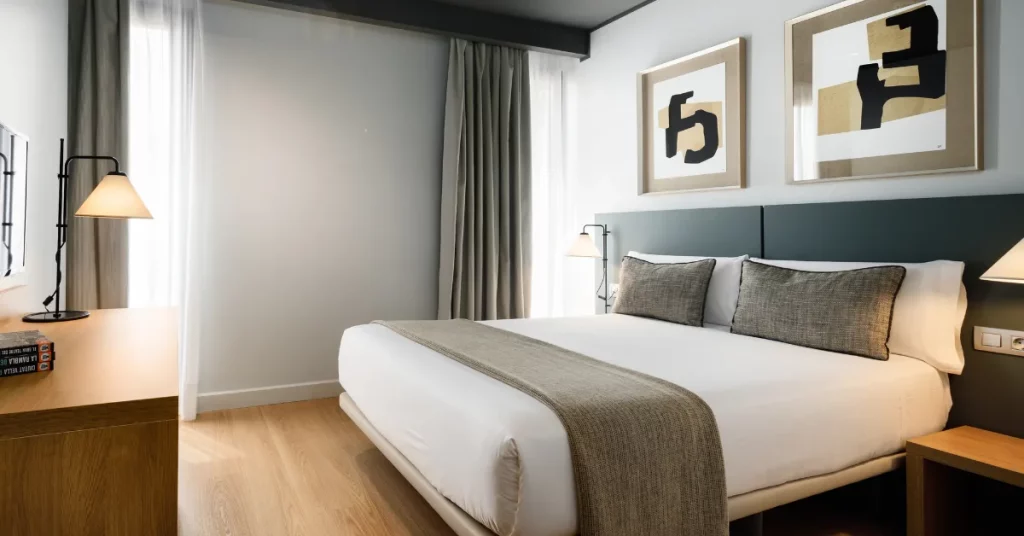
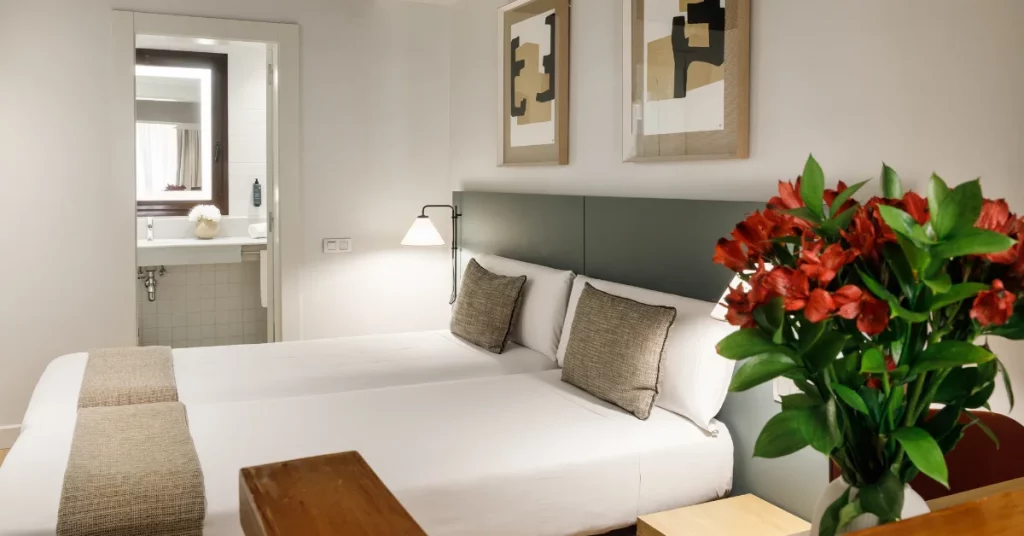
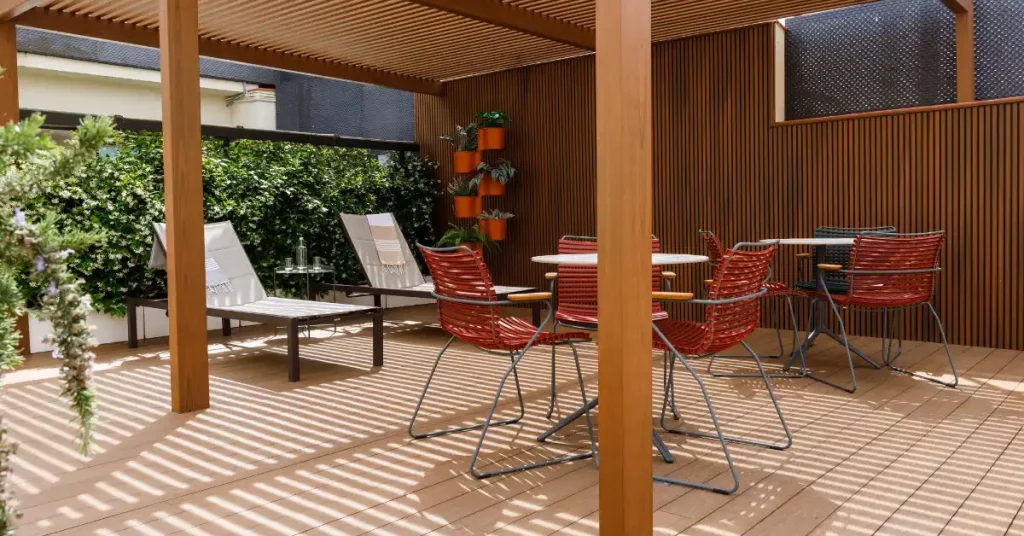
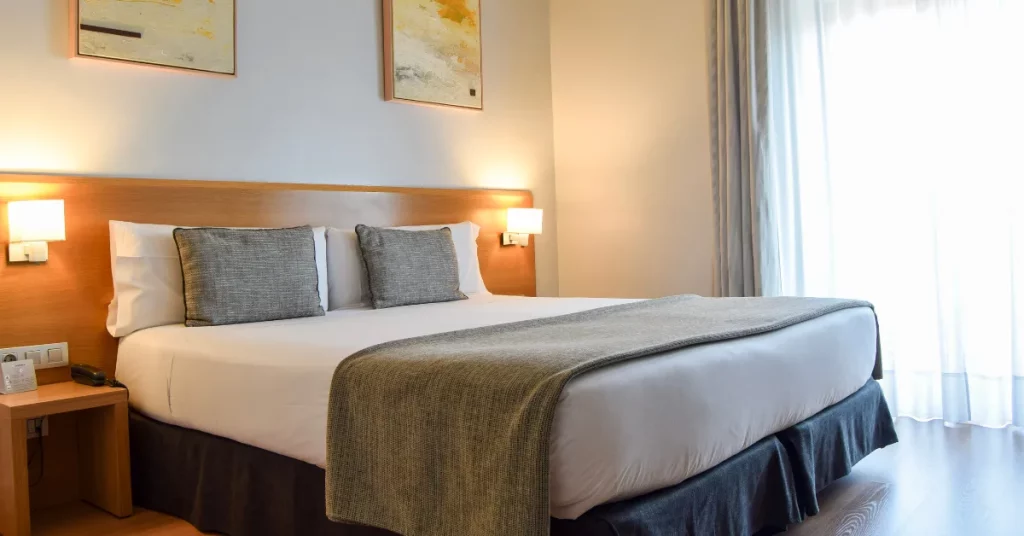
From Hotel Arc La Rambla (La Rambla 19-21, next to Drassanes metro, L3), reaching the Fundació Joan Miró is easy: connect to Paral·lel and go up Montjuïc by funicular, or take a bus straight up the hill. A perfect location for spending a day on Montjuïc —Miró, MNAC, Poble Espanyol, the Magic Fountain— and returning to the centre to enjoy the Gothic Quarter, the harbour and La Boqueria, all steps from the hotel.
💡 Book on our website with the code ARCBLOG and enjoy a special perk as a blog reader.
Fundació Joan Miró — frequently asked questions
How much does it cost to enter the Fundació Joan Miró?
General admission costs €17 online and €18 on-site. The reduced rate (13 to 25, over-65s and Barcelona Libraries Card holders) is €11, and under-12s enter free, as do the unemployed, ICOM members and Friends of the Fundació. It’s also free with the Barcelona Card and included in the Articket.
What are the Fundació Joan Miró opening hours?
From November to March it opens Tuesday to Sunday from 10:00 to 19:00. From April to October, Tuesday to Saturday from 10:00 to 20:00 and Sundays from 10:00 to 19:00. Closed on Mondays (except some holidays). Last entry is 30 minutes before closing.
How do you get to the Fundació Joan Miró?
By buses 55 and 150 (Parc de Montjuïc), the Bus Turístic (Red Route), or by combining the metro to Paral·lel (L2/L3) with the Montjuïc Funicular. You can also arrive by the Montjuïc cable car.
Who designed the Fundació Joan Miró building?
Architect Josep Lluís Sert, a close friend of Joan Miró and one of the key figures of 20th-century architecture. The Rationalist building, opened in 1975, is considered one of the finest examples of museum architecture in the world.
How long do you need for the visit?
About 1.5 to 2 hours is recommended for the permanent collection, plus extra time if there’s a temporary exhibition you want to see and to enjoy the terraces and views.


