


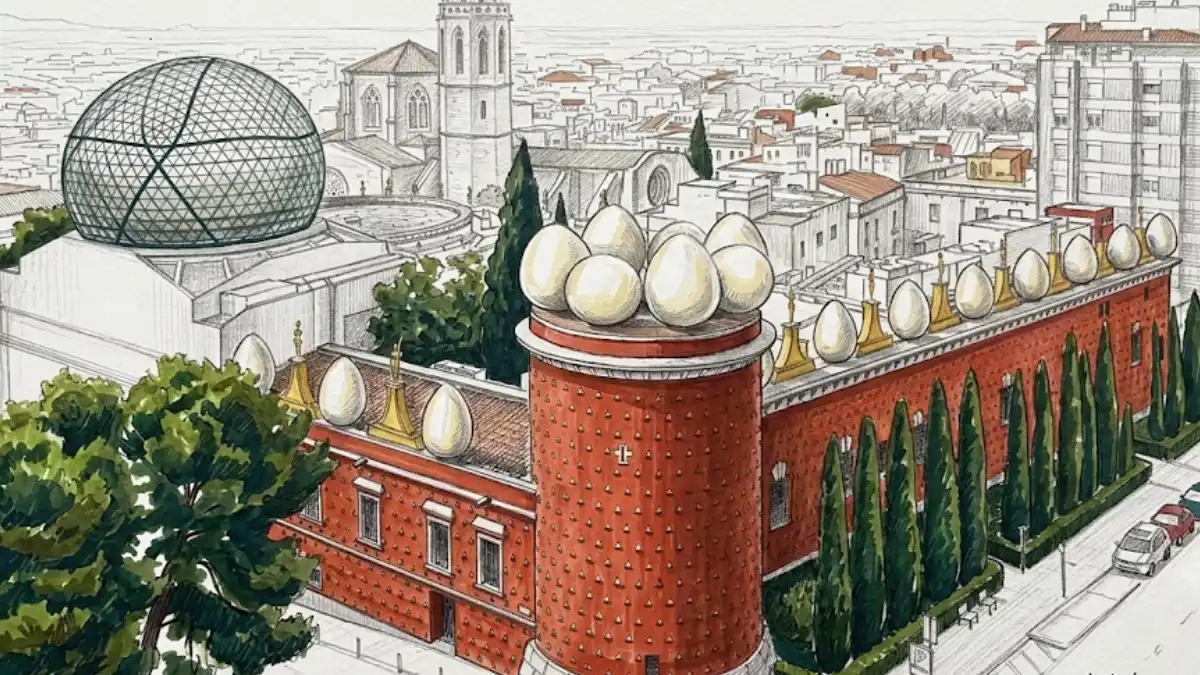
The Dalí Theatre-Museum in Figueres is the most important Surrealist museum in the world and one of the most visited in Spain. It was designed by Salvador Dalí himself on the ruins of the old Municipal Theatre in his home town, and he opened it in 1974; the artist is buried in a crypt beneath the stage. It’s not a conventional museum: it’s a work of art in its own right, with its geodesic dome, the Mae West room, the Rainy Taxi and the Dalí·Joies jewellery collection. It’s under an hour by high-speed train from Barcelona (about 2 h by regional train). The visit is self-guided and takes 1.5 to 2 hours.
Other excursions…

What is the Dalí Theatre-Museum?
There are museums about an artist, and then there’s this one, which is directly a work by the artist. Salvador Dalí was born in Figueres in 1904, and there, on the ruins of the old Municipal Theatre —the very building where he first exhibited as a boy, destroyed at the end of the Civil War— he built the museum he conceived, designed and directed himself. He opened it in 1974 and worked on it until the end of his life.
Dalí described it as a place where visitors should leave feeling they’d had a theatrical dream. And that’s exactly what happens: there’s no logical or chronological route, but a succession of surprises, optical illusions, in-jokes and provocations placed there by him. Dalí is buried in a crypt beneath the stage, at the heart of his own creation.
You can spot the building from a distance: crowned by a great transparent geodesic dome, its façade is decorated with giant eggs and bread rolls. The adjoining tower, the Torre Galatea, was added to the complex in the 1980s and is where the artist spent his final years.
What to see inside the museum
The central courtyard and the Rainy Taxi
The route begins in the former stalls, now open to the sky. At its centre sits the Rainy Taxi (Taxi plujós): a black Cadillac in which it actually rains inside. One of the first coups de théâtre and one of the museum’s most photographed pieces.
The Mae West room
Probably the most famous space. A room of furniture —a sofa shaped like lips, two paintings as eyes, a fireplace as a nose— which, viewed from the exact spot through a lens, transforms into the face of the actress Mae West. A masterclass in perspective and optical illusion that fascinates everyone. There’s usually a queue for the viewer: be patient, it’s worth it.
The dome and the stage
Beneath the great geodesic dome opens the theatre’s former stage, presided over by major works by the artist. Below it, discreetly marked, lies the crypt with Dalí’s tomb.
The Palace of the Wind and the collection
The Palace of the Wind room, with its spectacular painted ceiling, is another of the great moments. Along the route unfolds a collection covering Dalí’s entire career, from his early Impressionist and Cubist experiments through Surrealism to his final works, plus pieces by other artists from his personal collection.
Dalí·Joies
An adjoining space houses Dalí·Joies, the collection of jewels designed by the artist: gold and precious-stone pieces in impossible shapes, some with moving mechanisms, such as the celebrated beating heart. It’s included in your ticket and many people skip it without realising: don’t.
How to get to Figueres from Barcelona
| Option | Arrival station | Duration | Station to museum |
|---|---|---|---|
| High speed (AVE / AVANT) from Barcelona-Sants | Figueres-Vilafant | About 55 minutes | 20-25 min on foot, or bus/taxi |
| Regional train (MD / Regional) from Sants, Passeig de Gràcia or El Clot-Aragó | Figueres (centre) | About 2 hours | 10-12 min on foot |
| Car | — | About 2 hours | AP-7, Figueres exit, or N-II |
| Organised excursion | — | Full day | Transport and tickets included |
💡 Tip: buy your train ticket in advance. High-speed fares rise steeply at the last minute, and booking weeks ahead turns up considerably better prices.
Hours, tickets and duration
| Item | Detail |
|---|---|
| Hours | Vary considerably by season; there’s a weekly closing day in low season. Check the official website |
| Ticket | Paid, with an assigned time slot. Buy online in advance |
| Includes | Theatre-Museum + Dalí·Joies collection |
| Type of visit | Self-guided (no compulsory guided route) |
| Recommended duration | 1.5 to 2 hours |
Make a day of it: the rest of Figueres
Something almost nobody mentions: your Theatre-Museum ticket gets you a discount at other museums in town on the same day. If you’re devoting a full day to it, make the most of that:
- Salvador Dalí’s Birthplace (carrer Monturiol): the house where the artist was born, visited in small groups with staggered entry times. Reduced price on showing your museum ticket.
- Museu del Joguet de Catalunya (Toy Museum): an unexpected gem, with thousands of historic toys on display, including the teddy bear shared by Dalí and Federico García Lorca. Discount also applies.
- Castell de Sant Ferran: an enormous 18th-century military fortress, among the largest in Europe, a quarter of an hour uphill from the centre. Very cheap entry.
Practical tips for your visit
- Buy your ticket online with a time slot: booking a time is required and slots sell out.
- Leave Barcelona early: arriving mid-morning gives you time for the museum, lunch in Figueres and a second museum in the afternoon.
- Check which station your train arrives at before buying it (see the notice above).
- Don’t look for a logical order: the museum is designed as a dreamlike route. Go with it, and look up: there’s work on ceilings and in unexpected corners.
- Save time for Dalí·Joies: it’s included and many people miss it.
- Accessibility: the building is a former theatre with many levels and staircases; if you travel with reduced mobility, check access conditions beforehand.
- Late slots are usually the quietest for the Mae West room.
Hotel Arc La Rambla, with a direct metro to the Figueres trains
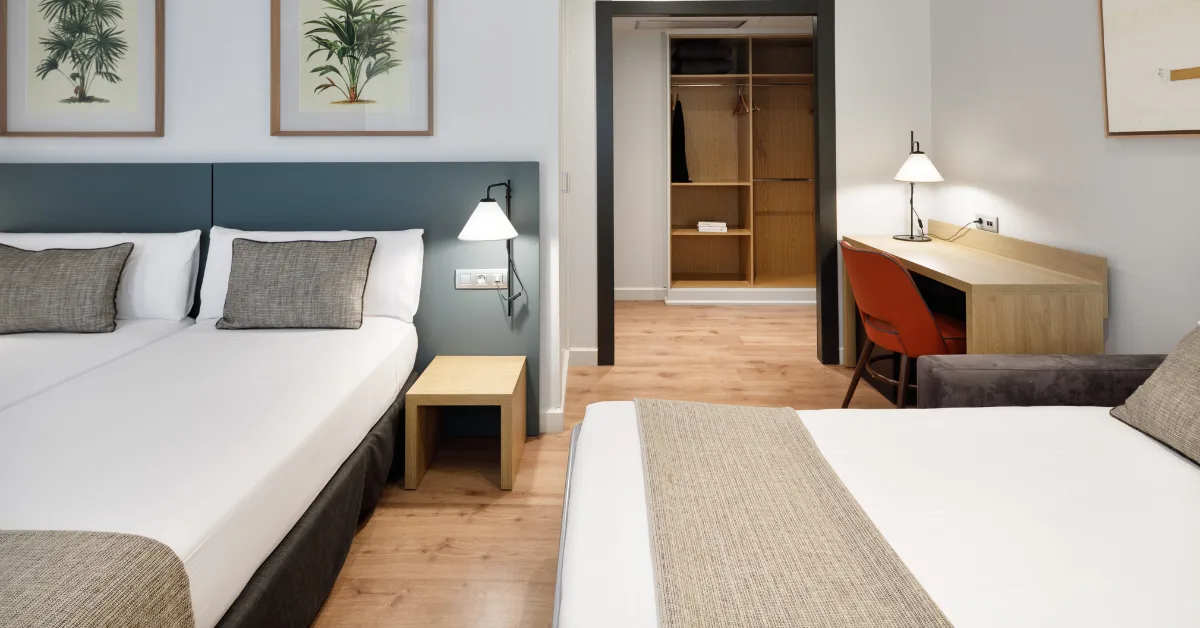
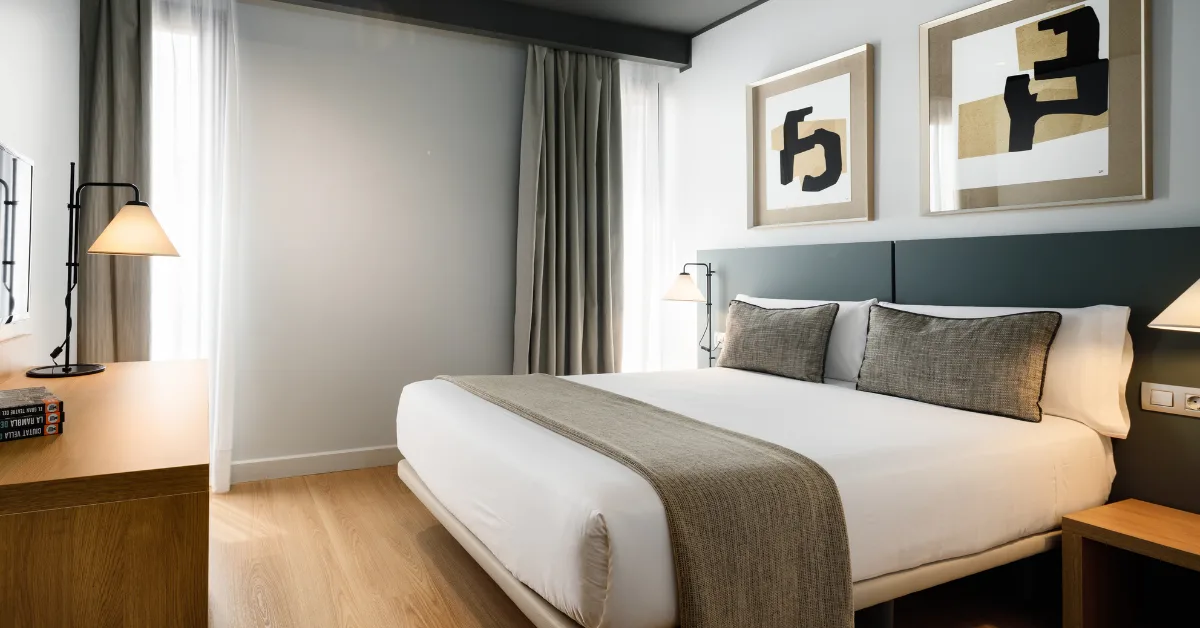
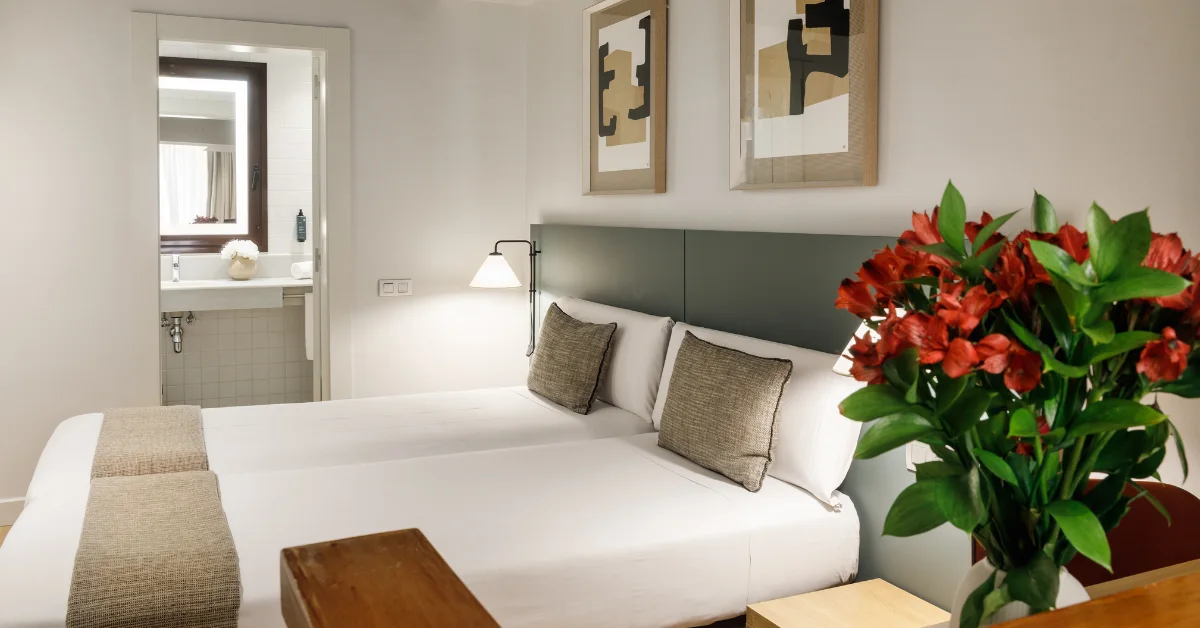
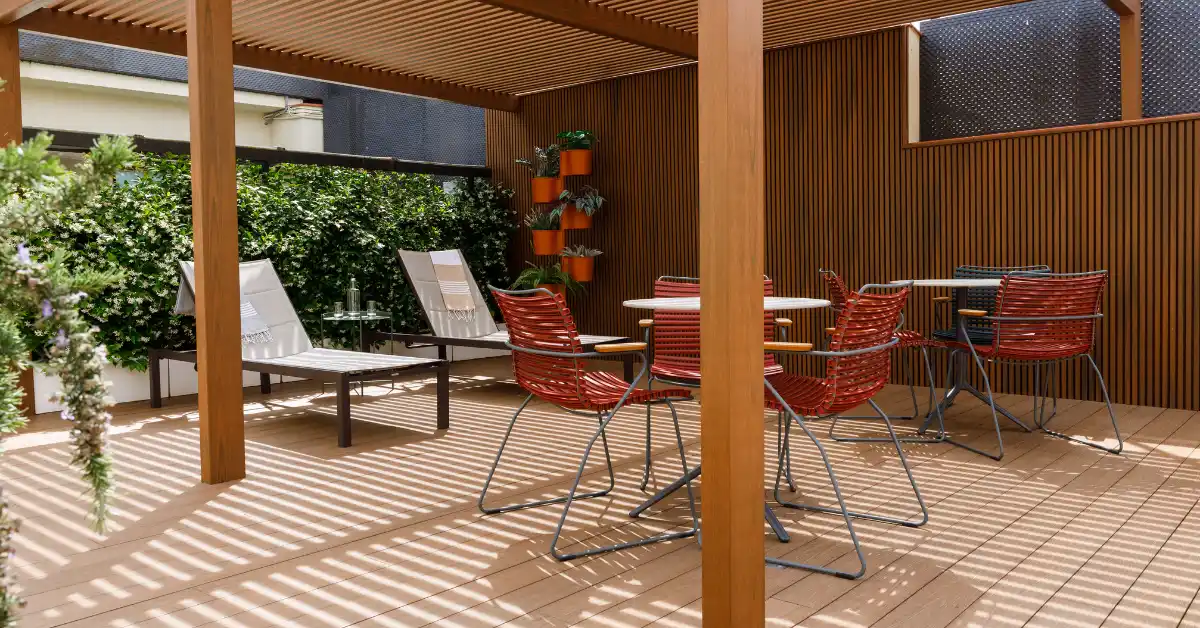
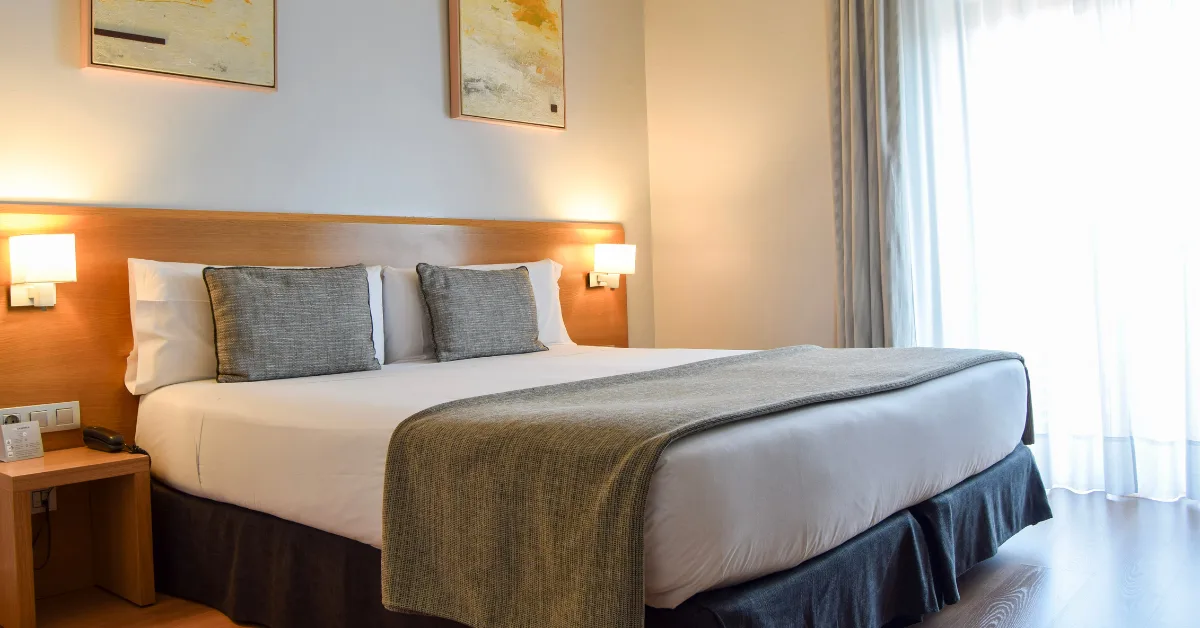
For a day trip like this, an easy early start is everything. From Hotel Arc La Rambla (La Rambla 19-21, next to Drassanes metro), metro line 3 takes you with no changes to both Barcelona-Sants (where the high-speed trains depart) and Passeig de Gràcia (where the regional trains to Figueres also stop). You’re on the platform within minutes, and on your return the old town, Las Ramblas and the harbour are steps away to round off the day.
💡 Book on our website with the code ARCBLOG and enjoy a special perk as a blog reader.
Dalí Museum in Figueres — frequently asked questions
How do you get to the Dalí Museum from Barcelona?
There are two train options. The high-speed train (AVE or AVANT) leaves from Barcelona-Sants and reaches Figueres-Vilafant in about 55 minutes, but that station is some 20-25 minutes on foot from the museum. The regional train leaves from Sants, Passeig de Gràcia or El Clot-Aragó and takes about 2 hours, but arrives at Figueres central station, only 10-12 minutes’ walk from the museum.
How long does it take to visit the Dalí Theatre-Museum?
The visit is self-guided, with no compulsory guided route, and most people spend 1.5 to 2 hours. Anyone wanting to linger in each room and in the Dalí·Joies jewellery collection can stretch it a little longer. You should also allow roughly 2 to 4 hours of total travel from Barcelona, depending on the type of train.
Is Dalí buried in the museum?
Yes. Salvador Dalí is buried in a crypt beneath the stage of the old Municipal Theatre, at the heart of the very museum he designed. The artist died in 1989 in Figueres, the town where he had been born in 1904.
Do you need to book tickets for the Dalí Museum?
Yes, it’s strongly recommended. Tickets are sold with assigned time slots and frequently sell out in high season and at weekends. The best approach is to buy online in advance on the official Fundació Gala-Salvador Dalí website. The ticket also includes the Dalí·Joies jewellery collection.
What else can you visit in Figueres?
Your Theatre-Museum ticket entitles you to a same-day discount at other sites in town, such as Salvador Dalí’s Birthplace, where the artist was born, and the Museu del Joguet de Catalunya, with thousands of historic toys. The Castell de Sant Ferran, one of the largest fortresses in Europe, a quarter of an hour’s walk from the centre, is also well worth it.


