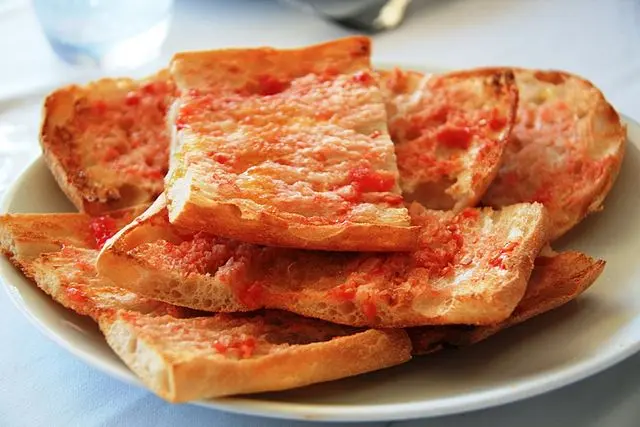
Catalan cuisine is one of the oldest and most celebrated in the Mediterranean. If you are visiting Barcelona and wondering what to eat, this guide brings together 20 typical Catalan dishes — from quick tapas like pa amb tomàquet and fried olives to slow-cooked classics such as fricandó and canelons — each with its own description, ingredients, cooking time and step-by-step recipe.
At the end you will also find clear answers to the most common questions travellers ask about Catalan food: how it differs from Spanish cuisine, what Barcelona is famous for, and which dishes Catalonia is best known for.

A quick guide: what makes Catalan food different
Catalan cuisine sits at the crossroads of mountain and sea (mar i muntanya), with a rural backbone of bread, olive oil, garlic, ripe tomatoes, almonds and salt cod, and a coastal repertoire built around fresh fish, cuttlefish, anchovies and rice. Many recipes are medieval in origin and appear in cookbooks like the 14th-century Llibre de Sent Soví, which makes Catalonia one of the oldest documented food cultures in Europe.
Most traditional Catalan recipes share four building blocks: a slow sofregit (onion and tomato base), a picada (a mortar paste of garlic, parsley, nuts and bread that thickens stews), olive oil from local PDOs such as Siurana or Empordà, and a strong link to a calendar of feast days — Sant Josep in March, Sant Joan in June, La Castanyada on All Saints’ Eve, Sant Esteve the day after Christmas.
1. Pa amb tomàquet (Catalan tomato bread)
The everyday symbol of Catalan cuisine: rustic bread rubbed with ripe tomato, a thread of extra virgin olive oil and a pinch of salt. It is served with cured meats, cheese, anchovies or simply on its own, at any time of day.
Time: 5–10 minutes · Serves: 2
Ingredients
- 4 thick slices of rustic country bread (pa de pagès, sourdough)
- 2 ripe tomàquets de penjar or vine tomatoes, halved
- 1 garlic clove, peeled and halved (optional)
- Extra virgin olive oil (Arbequina if possible)
- Coarse sea salt
Steps
- Lightly toast the bread on a grill, in a pan or under the oven broiler until golden and crisp on both sides.
- While still warm, rub the cut side of the garlic clove over the surface of each slice.
- Rub the cut side of half a tomato over the bread, pressing gently so the pulp and juice soak in. Discard the skin.
- Drizzle generously with extra virgin olive oil and finish with a pinch of sea salt.
- Serve immediately, on its own or as a base for ham, cheese, anchovies or escalivada.
2. Bacallà a la llauna (tin-baked salt cod)
Description. One of the most defining cod dishes in Catalan cuisine. Floured salt cod loins are pan-fried, then baked in a metal tray (llauna) with garlic, sweet paprika and white wine. Traditionally eaten during Lent.
Time: 30 minutes (plus 24–48 hours desalting) · Serves: 4
Ingredients
- 4 thick salt cod loins, desalted
- Wheat flour, for coating
- 4 garlic cloves, sliced
- 1 tsp sweet smoked paprika
- 100 ml dry white wine
- Fresh parsley, chopped
- Extra virgin olive oil
- Optional: cooked white beans, to serve
Steps
- Preheat the oven to 200 °C (400 °F).
- Pat the cod dry, coat lightly in flour and shake off the excess.
- In a pan with hot olive oil, fry the cod loins skin-side down for about 1–2 minutes per side until lightly golden. Transfer to a baking tray, skin side down.
- In the same oil, gently brown the sliced garlic. Off the heat, stir in the paprika so it does not burn.
- Add the white wine, return to the heat for a minute to evaporate the alcohol, then pour the sauce over the cod.
- Bake for 8–10 minutes. Sprinkle with parsley and serve hot, with white beans or patatas panaderas if desired.
3. Fricandó (Catalan beef and mushroom stew)
Description. A slow-cooked beef stew with wild mushrooms (traditionally moixernons) and picada, dating back to 18th-century Catalan cookbooks. Often considered the king of Catalan stews.
Time: 2 hours 30 minutes · Serves: 4
Ingredients
- 800 g beef shoulder or llata, cut into thin slices
- Flour, for dusting
- 1 large onion, finely chopped
- 1 carrot, diced
- 2 ripe tomatoes, grated
- 30 g dried wild mushrooms + 200 g fresh mushrooms
- 100 ml white wine or red wine
- 500 ml beef broth
- 2 bay leaves
- Salt, pepper, olive oil
- For the picada: 1 garlic clove, a small handful of toasted almonds and hazelnuts, parsley, 1 slice of fried bread
Steps
- Soak the dried mushrooms in warm water for 20 minutes. Drain (keep the liquid).
- Season the beef, dust with flour, and brown in olive oil in a heavy pot. Set aside.
- In the same pot, sauté the onion and carrot until golden. Add the tomato and cook 10 minutes until reduced to a thick sofregit.
- Return the beef to the pot, add wine and reduce. Pour in the broth and mushroom water, add bay leaves and the soaked mushrooms.
- Cover and simmer over low heat for 1.5–2 hours until the meat is fork-tender.
- Make the picada by pounding garlic, nuts, parsley and fried bread in a mortar with a little broth.
- Sauté the fresh mushrooms and add to the pot with the picada. Cook 10 more minutes and serve. It tastes even better the next day.
4. Crema catalana (Saint Joseph’s burnt cream)
Catalonia’s most famous dessert and one of Europe’s oldest recorded sweets, dating back to the 14th century. A creamy custard flavoured with lemon, orange and cinnamon, finished with a brittle, caramelised sugar crust. Traditionally eaten on Sant Josep (19 March), Catalonia’s Father’s Day.
Time: 30 minutes (plus 4 hours chilling) · Serves: 6
Ingredients
- 1 litre whole milk
- 8 egg yolks
- 200 g sugar (plus extra for the topping)
- 30 g cornstarch
- 1 cinnamon stick
- 1 strip of lemon peel
- 1 strip of orange peel
Steps
- Heat the milk in a saucepan with the cinnamon stick and citrus peels until just before boiling. Remove from the heat and let infuse for 10 minutes.
- In a bowl, whisk the egg yolks with sugar until pale, then beat in the cornstarch.
- Strain the warm milk and slowly pour it over the yolks, whisking constantly.
- Return to the pan over low heat and stir continuously until it thickens to a custard. Do not let it boil.
- Pour into shallow earthenware ramekins, cool, then refrigerate for at least 4 hours.
- Just before serving, sprinkle a thin, even layer of sugar on top and burn it with a hot iron (pala de cremar) or a kitchen torch until golden and crackling.
5. Xató (winter salad with romesco-style sauce)
An emblematic cold salad from the Garraf and Penedès coast, famously associated with Sitges and Vilanova i la Geltrú. It combines curly endive, salt cod, tuna, anchovies and Arbequina olives, dressed with a thick xató sauce similar to romesco. Local festivals called xatonades are held every winter.
Time: 25 minutes · Serves: 4
Ingredients
- 1 head of frisée / curly endive
- 200 g desalted shredded salt cod
- 100 g good-quality tuna in olive oil, drained
- 8 anchovy fillets in olive oil
- A handful of Arbequina or black olives
- A few radishes, sliced
- For the xató sauce: 2 ñoras (dried red peppers, soaked), 1 small roasted red pepper, 50 g toasted almonds, 50 g toasted hazelnuts, 2 garlic cloves, 1 small piece of fried bread, 1 tbsp sherry vinegar, 100 ml extra virgin olive oil, salt
Steps
- Drain and de-seed the soaked ñoras and scrape out the flesh.
- In a mortar, crush the garlic and salt, then add the nuts and grind to a paste.
- Add the ñora pulp, roasted pepper and fried bread. Continue grinding.
- Slowly drizzle in the olive oil while pounding to emulsify, then add the vinegar. Adjust salt.
- Arrange the frisée, shredded cod, tuna, anchovies, olives and radishes on a platter.
- Dress with the xató sauce just before serving, or pass the sauce at the table.
6. Arròs fosc de l’Empordà (Empordà-style “dark” rice)
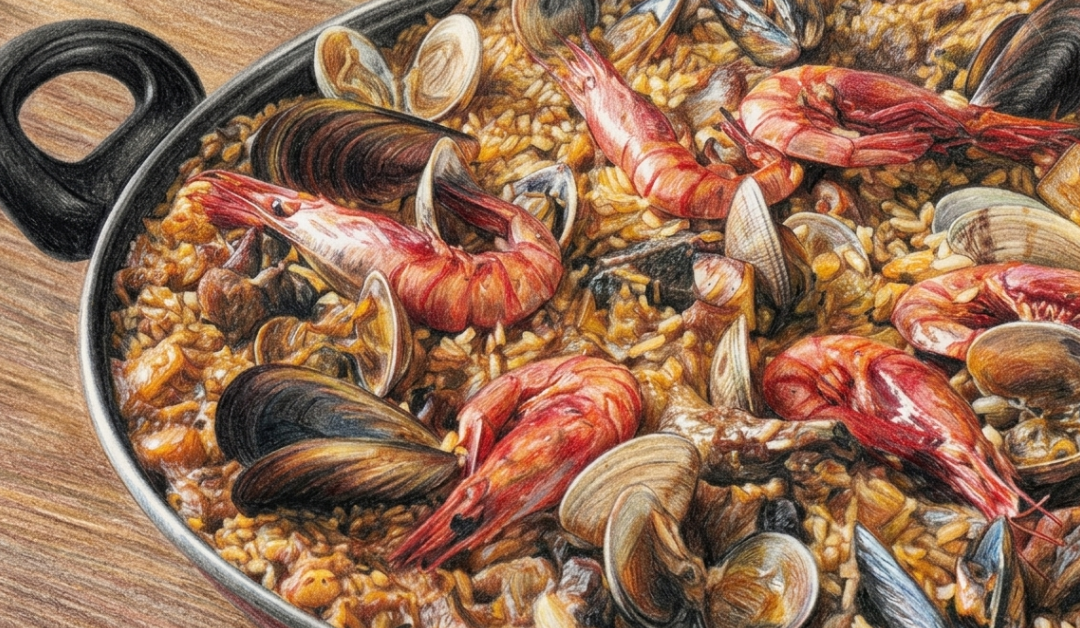
A rustic seafood-and-meat rice from the Empordà region, named not for squid ink but for the deep, almost black colour of its long, slowly caramelised onion sofregit. Cooked in a paella pan or cast-iron pot, it combines pork ribs, sausage, cuttlefish, prawns and a picada.
Time: 1 hour 30 minutes · Serves: 4
Ingredients
- 320 g short-grain rice (Bomba or Calasparra)
- 200 g pork ribs, chopped
- 1 fresh pork sausage, sliced
- 200 g cuttlefish, cleaned and diced (keep the liver if possible)
- 8 large prawns or langoustines
- 2 large onions, finely chopped
- 1 green pepper, chopped
- 1 ripe tomato, grated
- 2 garlic cloves
- 100 ml white wine
- 1 litre hot fish broth
- For the picada: 1 garlic clove, parsley, the cuttlefish liver
- Olive oil, salt
Steps
- Heat olive oil in a paella pan. Sear the prawns 30 seconds per side and set aside.
- Sauté the cuttlefish briefly, then set aside.
- Brown the ribs and sausage and reserve with their juices.
- In the same pan, start the sofregit: cook the onion over high heat for 5 minutes, then lower the heat. Stir patiently for up to one hour, adding a few drops of water if needed, until very dark and confit-like.
- Add the green pepper and garlic, cook 3–4 minutes, then the grated tomato. Reduce until very dark.
- Return the meat and cuttlefish to the pan and pour in the wine. Reduce 5 minutes.
- Make the picada in a mortar with garlic, parsley and the cuttlefish liver, loosened with a spoon of broth.
- Add the rice and stir for 2 minutes. Pour in the hot broth, add the picada, season, and cook 16–18 minutes without stirring. Add the prawns in the last 5 minutes. Rest 5 minutes before serving.
7. Torrades de Santa Teresa (Catalan-style French toast)
The Catalan cousin of torrijas and French toast, traditionally eaten during Lent and Easter. Day-old bread is soaked in cinnamon-and-lemon-infused milk, dipped in egg and fried, then sprinkled with sugar. A clear example of zero-waste convent cooking.
Time: 25 minutes · Serves: 4
Ingredients
- 8 thick slices of day-old bread (baguette or country loaf)
- 500 ml whole milk
- 1 strip of lemon peel
- 1 cinnamon stick
- 2 eggs, beaten
- Sugar, for dusting
- Olive oil or butter, for frying
- Optional: ground cinnamon
Steps
- Heat the milk in a saucepan with the lemon peel and cinnamon stick. Bring to a gentle boil, remove from the heat and let infuse for 10 minutes.
- Strain the milk into a wide dish and let it cool slightly.
- Beat the eggs in another dish.
- Briefly soak each slice of bread in the warm milk — long enough to absorb flavour but not fall apart — then dip in the egg.
- Fry on both sides in hot oil or butter until golden and crisp.
- Drain on a wire rack and serve warm, dusted with sugar (and ground cinnamon if you like).
8. Escalivada (roasted Catalan vegetables)
Description. One of the oldest cooking techniques in Catalonia. The name comes from escalivar, “to cook in embers”. Eggplants, red peppers and onions are slow-roasted, peeled, torn into strips and dressed with olive oil and salt. Often served on toasted pa de pagès with anchovies.
Time: 1 hour · Serves: 4
Ingredients
- 2 eggplants
- 2 red bell peppers
- 2 large onions, unpeeled
- Extra virgin olive oil
- Sea salt
- Optional: anchovy fillets and toasted country bread, to serve
Steps
- Preheat the oven to 200 °C (395 °F).
- Wash the peppers and eggplants, rub them with olive oil and a little salt. Wrap the unpeeled onions in aluminium foil.
- Place everything on a baking tray and roast for about 45 minutes, until the skins are blistered and the vegetables soft.
- Cover the peppers and eggplants with a clean cloth or plate so they steam — this makes them easier to peel.
- Peel the vegetables, remove the seeds and tear the flesh into long strips.
- Arrange on a plate, season with salt and a generous drizzle of olive oil. Serve at room temperature, plain or topped with anchovies on toast.
9. Canelons (Catalan-style cannelloni)
A Catalan icon despite its Italian roots. Brought to Barcelona by 19th-century Italian chefs, canelons became the traditional dish of Sant Esteve (Boxing Day, 26 December), made with leftover Christmas roast meats, rolled in pasta sheets, covered in béchamel and grated cheese, and baked.
Time: 1 hour 45 minutes · Serves: 4
Ingredients
- 16 cannelloni pasta sheets
- 250 g pork shoulder
- 250 g beef
- 200 g chicken (or leftover roast meat)
- 2 chicken livers (optional)
- 1 onion, 1 carrot, 1 leek, finely chopped
- 2 garlic cloves
- 1 tomato
- 1 bay leaf, a pinch of cinnamon, nutmeg, salt, pepper
- 50 ml vi ranci, sherry or brandy
- For the béchamel: 60 g butter, 60 g flour, 700 ml hot milk, nutmeg, salt
- 100 g grated cheese (Emmental or Parmesan)
Steps
- Preheat the oven to 190 °C (375 °F). Place the meats and chopped vegetables in a baking dish with garlic, bay leaf, cinnamon, nutmeg, salt and pepper. Drizzle with olive oil. Roast for 45 minutes, add the vi ranci, then continue 30 more minutes.
- Boil the pasta sheets according to the package, drain and lay flat on a clean cloth.
- Finely chop or blend the roasted meats and vegetables with a few spoonfuls of the cooking juices.
- For the béchamel, melt the butter, stir in the flour and cook 2 minutes. Slowly whisk in the hot milk until smooth. Season with nutmeg and salt. Stir a little béchamel into the meat filling.
- Place a spoonful of filling on each pasta sheet, roll into a tube and arrange seam-side down in a buttered baking dish.
- Cover with béchamel, sprinkle with grated cheese and bake at 200 °C (400 °F) for 15–20 minutes until golden.
10. Brandada de bacallà (Catalan salt cod spread)
A creamy emulsion of salt cod, garlic, olive oil and milk (sometimes potato), originally from Occitan cuisine and adopted by Catalonia. Traditionally eaten on Christmas Eve, sometimes upgraded with black truffle (brandada de dol).
Time: 30 minutes (plus desalting) · Serves: 4
Ingredients
- 400 g desalted salt cod, skinned and deboned
- 1 small potato, peeled
- 2 garlic cloves
- 200 ml extra virgin olive oil, warmed
- 100 ml whole milk, warmed
- Black pepper
- Breadcrumbs, for the gratin
Steps
- Boil the potato until tender. Set aside.
- Cover the cod with cold water, bring to a boil and immediately turn off the heat. Let it sit 15 minutes, then break into flakes.
- Gently sauté the garlic in a little oil until lightly golden (about 1 minute).
- In a food processor or mortar, blend the cod, potato, garlic and a pinch of pepper. With the blade running, slowly stream in the warm oil and warm milk until you get a smooth, mayonnaise-like cream.
- Transfer to small ovenproof dishes, sprinkle with breadcrumbs and broil until golden. Serve warm with toast.
11. Carquinyolis (Catalan almond biscotti)
Description. Crunchy twice-baked almond biscuits dating from the 19th century, particularly famous in Caldes de Montbui, Vic and Cardedeu. The classic companion of sobretaula (after-meal conversation), dipped in coffee, moscatell or sweet vi ranci.
Time: 50 minutes · Serves: about 25 biscuits
Ingredients
- 175 g flour
- 100 g sugar
- 100 g whole almonds, with skins
- 1 large egg
- 1 tsp baking powder
- 1 tsp ground cinnamon (optional)
- Zest of 1 lemon
- A small splash of anise liqueur
- A pinch of salt
Steps
- Preheat the oven to 180 °C (360 °F). Place the almonds in a bowl with the anise liqueur for a few minutes (optional, traditional in some regions).
- In a large bowl, whisk the egg with the sugar and lemon zest until pale.
- Mix the flour, baking powder, cinnamon and salt, then fold into the egg mixture.
- Drain the almonds and add to the dough. Knead briefly until just combined.
- Shape the dough into a long log about 3 cm wide on a parchment-lined baking tray.
- Bake for 20–25 minutes until firm and lightly golden.
- Remove from the oven, let rest 5 minutes, then slice diagonally into thin biscuits. Return to the oven for 5–8 minutes until crisp. Cool completely before storing.
12. Panellets (All Saints’ marzipan sweets)
Small marzipan-based sweets eaten on All Saints’ Eve (La Castanyada, 31 October), alongside roasted chestnuts and sweet potatoes. The most traditional version is rolled in pine nuts, but you will find them coated in coconut, almonds, coffee, chocolate or quince paste.
Ingredients
- 250 g almond flour
- 200 g sugar
- 1 small boiled potato or sweet potato, mashed (about 100 g)
- 1 egg + 1 extra egg, beaten, for brushing
- Zest of 1 lemon
- 150 g pine nuts (for the classic version)
Steps
- In a bowl, mix the almond flour, sugar, mashed potato, lemon zest and the unbeaten egg until you get a smooth, even paste.
- Cover and refrigerate for 24 hours so the natural oils blend.
- The next day, roll the dough into walnut-sized balls (about 20 g each).
- Dip each ball in the beaten egg, then roll firmly in pine nuts so they stick all over.
- Brush again with egg, place on a parchment-lined tray and bake at 200–220 °C (400–425 °F) for 8–10 minutes until the pine nuts are golden. Watch closely so they don’t burn.
13. Olives fregides (fried olives)
A simple, irresistible Catalan tapa often served at vermut time — the Sunday-morning ritual of fer el vermut, a glass of vermouth with salty snacks before the midday meal. Hot, slightly crispy olives finished with sea salt and rosemary.
Time: 10 minutes · Serves: 4
Ingredients
- 200 g good-quality green or black olives, drained and patted dry
- 2 tbsp extra virgin olive oil
- A few sprigs of fresh rosemary
- Maldon or coarse sea salt
- Optional: 1 garlic clove, a strip of orange peel
Steps
- Heat the olive oil in a small pan until shimmering.
- Add the olives (and the optional garlic and orange peel), cover, and fry for 4–5 minutes, stirring occasionally, until lightly blistered.
- Transfer to a serving plate, sprinkle with Maldon salt and top with a few rosemary sprigs. Serve hot, ideally with a glass of vermouth.
14. Pèsols amb sípia (peas with cuttlefish)
Description. A classic mar i muntanya dish from the Maresme coast just north of Barcelona, where the prized Llavaneres pea — “the green pearl of Maresme” — meets fresh cuttlefish in a tomato-based stew enriched with picada.
Time: 1 hour · Serves: 4
Ingredients
- 600 g cuttlefish, cleaned and cut into 2–3 cm pieces
- 400 g fresh or frozen peas
- 1 onion, finely chopped
- 1 ripe tomato, grated
- 50 ml vi ranci or dry sherry
- 500 ml fish broth
- Olive oil, salt
- For the picada: 1 garlic clove, parsley, 8 toasted almonds, 8 toasted hazelnuts, 1 small slice of fried bread
Steps
- Brown the cuttlefish over high heat in a casserole with olive oil. Add the onion and cook over medium heat until golden.
- Add the tomato and reduce for 5 minutes to form a sofregit.
- Pour in the vi ranci and reduce 2 minutes. Add the hot fish broth and simmer for 20 minutes.
- Make the picada in a mortar with garlic, parsley, nuts and fried bread, loosened with a spoonful of broth.
- Stir in the picada and add the peas. Cook 15 minutes for fresh peas or 8 minutes for frozen. Adjust salt and serve with crusty bread.
15. Sardines en escabetx (pickled sardines)
A medieval Catalan preservation method passed down from Roman and Arab influences. Sardines are floured, fried and bathed in a vinegar-and-oil pickle with garlic, paprika and herbs. Served cold as a tapa or starter, and even better after a couple of days in the fridge.
Time: 30 minutes (plus 24 hours marinating) · Serves: 4
Ingredients
- 800 g fresh sardines, gutted and cleaned
- Flour, for coating
- 200 ml extra virgin olive oil
- 100 ml white wine vinegar (or sherry vinegar)
- 50 ml dry white wine (optional)
- 4 garlic cloves, sliced
- 2 bay leaves
- 1 sprig of thyme, 1 sprig of rosemary
- 1 tsp sweet paprika
- Salt
Steps
- Salt the cleaned sardines and dust them lightly with flour.
- Fry quickly on both sides in hot olive oil — don’t overcook. Transfer to an earthenware or glass dish.
- In the same oil (cleaned of burnt bits), gently sauté the sliced garlic with the bay leaves and herbs for 4 minutes over low heat.
- Off the heat, stir in the paprika, then immediately pour in the vinegar (and white wine if using) so the paprika doesn’t burn. Return to a low boil for 2 minutes.
- Pour the warm marinade over the sardines, let cool, cover and refrigerate. Wait at least 24 hours — preferably 2–3 days — before serving cold.
16. Torró d’Agramunt (Catalan nougat)
Catalonia’s most famous Christmas nougat, with PGI status, made in the town of Agramunt (Lleida) since at least 1741. Round or rectangular bars of honey, sugar, egg white and whole hazelnuts (or almonds), pressed between thin wafer sheets.
Time: 1 hour · Serves: about 8
Ingredients
- 250 g whole roasted hazelnuts (or almonds), peeled and kept warm
- 250 g honey
- 100 g sugar
- 30 ml water
- A pinch of cream of tartar
- 1 egg white
- 2 sheets of edible wafer paper (neules / oblea)
Steps
- Heat the honey in a saucepan until it reaches 135 °C (275 °F) — soft-crack stage.
- In another saucepan, heat the water, cream of tartar and sugar until it reaches 145 °C (295 °F).
- Combine both mixtures while still hot.
- Whisk the egg white to stiff peaks. Slowly pour in the hot honey-sugar mixture while whisking until stiff peaks return.
- Return the mixture to low heat for a few minutes, then fold in the warm nuts.
- Line a baking tray with wafer paper, spread the nougat evenly, cover with another sheet of wafer paper and press down with a weight.
- Let cool completely before cutting into rectangles or rounds.
17. Mel i mató (fresh cheese with honey)
A medieval Catalan dessert of utmost simplicity: fresh, unsalted mató cheese drizzled with high-quality local honey (rosemary, thyme or orange blossom) and often topped with walnuts. Especially associated with Montserrat and the milkmaid’s market.
Time: 20 minutes (plus 2 hours draining) · Serves: 4
Ingredients
- 1 litre whole milk (cow, goat or a mix)
- 60 ml lemon juice (or 1/4 tsp vegetable rennet)
- Local honey, to serve
- Walnuts or almonds, to serve
- Optional: fresh figs, berries, lemon zest
Steps
- Heat the milk slowly until just before boiling (about 85 °C / 185 °F), stirring to prevent scorching.
- Remove from the heat. Add the lemon juice (or rennet, following package instructions) and stir gently for a few seconds.
- Let the milk sit undisturbed for 10–20 minutes until it curdles and the whey separates.
- Line a colander with cheesecloth and pour in the curds. Let drain for 1–2 hours over a bowl.
- Transfer the mató to small bowls or plates. Drizzle generously with honey, scatter walnuts on top and serve at cool room temperature.
18. Xips d’albergínia amb mel (eggplant chips with honey)
A modern Catalan tapa that nods to the country’s Andalusian-Arab heritage: thinly sliced eggplant, lightly floured and fried until crisp, finished with a drizzle of honey (often mountain honey or sugarcane molasses) and sometimes goat cheese.
Time: 25 minutes · Serves: 4
Ingredients
- 1 large eggplant
- 4 tbsp flour
- Sunflower or olive oil, for frying
- Honey (mountain, rosemary or sugarcane molasses)
- Sea salt
- Optional: crumbled goat cheese, shaved aged cheese
Steps
- Wash and dry the eggplant. With its skin on, slice it as thinly as possible (a mandoline is ideal).
- Place the slices in salted water (or salted milk) for 30–60 minutes to remove bitterness and excess moisture. Drain and pat very dry.
- Coat each slice in flour, shaking off the excess.
- Heat plenty of oil in a deep pan. Fry in small batches over medium-high heat until golden and crisp on both sides (1–2 minutes).
- Drain on kitchen paper and salt lightly.
- Arrange on a plate, drizzle generously with honey and, if you like, scatter with goat cheese. Serve immediately, while still hot and crunchy.
19. Ensaladilla Olivier (Catalan-style Russian salad)
Originally invented in Moscow in 1860 by French chef Lucien Olivier, this cold salad became one of the most beloved tapas in Barcelona’s bars. In Catalonia it is built around boiled potatoes, vegetables, tuna and homemade mayonnaise, often topped with anchovies or Arbequina olives.
Time: 40 minutes (plus chilling) · Serves: 4
Ingredients
- 500 g potatoes, peeled
- 1 carrot, peeled
- 100 g green beans
- 100 g peas (fresh or frozen)
- 2 eggs
- 1 jar of ventresca tuna in olive oil, drained and flaked
- 20 pitted Arbequina olives
- For the mayonnaise: 1 egg yolk, 200 ml sunflower oil, 50 ml mild olive oil, 1 tsp lemon juice, salt
- Optional: roasted red pepper, anchovy fillets, hard-boiled egg
Steps
- Place the potatoes, carrot and green beans in cold salted water and bring to a boil. Cook for 10 minutes.
- Add the peas and cook for another 5 minutes. Drain and let cool. Boil the eggs separately for 10 minutes.
- Make the mayonnaise: in a tall jug, combine the yolk, lemon juice, salt and oils. Place an immersion blender at the bottom, blend without moving until it starts to emulsify, then slowly pull it up.
- Dice the cooled potatoes, carrot, green beans and hard-boiled eggs into small cubes.
- In a large bowl, gently mix the vegetables, peas, tuna, olives and mayonnaise. Adjust salt.
- Chill at least 1 hour. Serve cold, garnished with roasted red pepper, anchovies or extra olives — and a glass of vermouth or cold beer.
20. Seitons en vinagre (fresh anchovies in vinegar)
A vermut-bar staple, especially using anchovies from L’Escala (Alt Empordà) — among the best in the world. Fresh anchovies are filleted, cured briefly in a vinegar-and-white-wine mix, then dressed with olive oil, garlic and parsley.
Time: 20 minutes (plus 10 hours marinating) · Serves: 4
Ingredients
- 500 g fresh anchovies, gutted, headed and filleted
- 150 ml white wine vinegar
- 100 ml dry white wine
- Salt
- 200 ml extra virgin olive oil
- 3 garlic cloves, finely chopped
- A handful of fresh parsley, finely chopped
Steps
- Arrange the cleaned anchovy fillets skin-side up in a deep dish, in a single layer.
- Salt them lightly. Pour over the vinegar-and-wine mixture (60 % vinegar, 40 % wine), making sure they are fully covered.
- Cover with cling film and refrigerate for 10 hours. The fillets should turn opaque white and firm.
- Drain and rinse briefly with cold water to remove excess vinegar. Pat dry.
- Mix the olive oil with the chopped garlic and parsley. Spread over the anchovies and layer them in a serving dish.
- Let them rest at least 30 minutes before serving. Best with toasted bread, Arbequina olives and a cold caña or vermouth.
Hotel Arc La Rambla — your basecamp for Barcelona’s cuisine
Most of these dishes are within a short walk of Hotel Arc La Rambla. From our location at La Rambla 19, in the heart of Ciutat Vella, you are around 5–10 minutes on foot from the Gothic Quarter, the Boqueria Market (a perfect first stop to see fresh anchovies, bacalao, mató and seasonal vegetables), Port Vell for fresh seafood, and a long line of traditional Catalan restaurants like Can Culleretes or 7 Portes. The metro Drassanes (L3) is one minute from our door, so day trips to calçotades in the Penedès or xatonades in Vilanova are easy too.
For more food inspiration, take a look at our guide to the best Catalan restaurants in Barcelona, our story on calçots in Barcelona, and traditional Catalan cuisine: 4 recipes to make at home.
If you would like a tip for a specific neighbourhood or dish, ask our front desk team — they live here, and they eat here.
Frequently asked questions about Catalan food
What is the difference between Spanish and Catalan food?
Spanish cuisine is an umbrella for many very different regional traditions, while Catalan cuisine is one specific regional cuisine within Spain, centred on Catalonia (Barcelona, Girona, Tarragona, Lleida). The main differences are:
- Geography and base ingredients. Catalan cooking is firmly Mediterranean — olive oil, ripe tomatoes, garlic, almonds, hazelnuts, salt cod, cuttlefish, anchovies, botifarra sausage and rice — and it expresses the mar i muntanya (sea and mountain) idea by mixing seafood with poultry or pork in the same dish (e.g. pollastre amb llagosta). Inland Spanish cuisines often lean more heavily on lamb, garlic soups, cocidos and stews.
- Signature techniques. Catalan recipes typically build on a slow sofregit (onion + tomato), a picada (mortar paste of nuts, garlic, parsley and bread that thickens the dish at the end), and sauces like romesco, allioli and xató. These are not standard across all Spanish regions.
- Iconic dishes. When most travellers think “Spanish food”, they think paella, gazpacho, tortilla, jamón ibérico — dishes mostly associated with Valencia, Andalusia and central Spain. Catalan emblems are different: pa amb tomàquet, escalivada, calçots with romesco, fricandó, canelons, crema catalana, mel i mató.
- Language and tradition. Many Catalan dishes are named in Catalan (a different Romance language from Spanish) and are tied to a Catalan ritual calendar — La Castanyada with panellets, Sant Josep with crema catalana, Sant Esteve with canelons, Nadal with escudella i carn d’olla.
In short, Catalan food is part of Spanish gastronomy but has its own ingredients, techniques and identity, with documented recipes going back to the 14th-century Llibre de Sent Soví, one of the oldest cookbooks in Europe.
What is Barcelona’s famous food?
Barcelona is famous above all for Catalan tapas, seafood and traditional desserts. The dishes most travellers come to try are:
- Pa amb tomàquet — Catalan tomato bread, served with almost everything.
- Escalivada — roasted eggplant, peppers and onions, often with anchovies on toast.
- Bombas de la Barceloneta — large potato croquettes with spicy brava sauce and allioli, born in the seaside neighbourhood.
- Calçots with romesco sauce — long sweet onions grilled over a fire, eaten in winter at calçotades.
- Bacallà a la llauna and brandada de bacallà — salt cod baked with paprika, or whipped into a creamy spread.
- Arròs negre and fideuà — short-grain rice with squid ink, or its noodle equivalent.
- Canelons — Boxing Day cannelloni with roast meat and béchamel.
- Crema catalana — citrus and cinnamon custard with a burnt sugar crust.
- Mel i mató — fresh cheese with honey and walnuts.
Cruise passengers and visitors staying near La Rambla also tend to discover Barcelona’s tapa culture (olives fregides, seitons en vinagre, ensaladilla Olivier) and the city’s famous markets, especially La Boqueria.
What food is Catalonia known for?
Catalonia is known for a Mediterranean cuisine built on humble, high-quality local ingredients — olive oil from PDOs like Siurana, Empordà, Les Garrigues, Terra Alta and Baix Ebre-Montsià; tomàquet de penjar; nuts from inland regions; salt cod; fresh fish from the coast; and rice from the Ebro Delta. Among its best-known dishes and products are:
- Sauces: romesco, allioli, picada, xató, salvitxada.
- Bread and vegetables: pa amb tomàquet, escalivada, coca de recapte, espinacs a la catalana.
- Stews and rice: fricandó, suquet de peix, escudella i carn d’olla, arròs negre, arròs fosc de l’Empordà, fideuà.
- Fish and seafood: bacallà a la llauna, brandada, sardines en escabetx, seitons en vinagre, pèsols amb sípia.
- Charcuterie and cheese: botifarra, fuet, llonganissa de Vic, fresh mató.
- Festive sweets: crema catalana (Sant Josep), panellets (La Castanyada), carquinyolis, torró d’Agramunt (Christmas), mel i mató, torrades de Santa Teresa (Lent).
- Wines and drinks: cava from Penedès, still wines from Priorat, Empordà, Montsant, vermut, ratafia, vi ranci, moscatell.
Catalonia is also home to a long lineage of pioneering chefs — Ferran Adrià, the Roca brothers, Carme Ruscalleda, Joan Roca — whose work has placed the region at the centre of world gastronomy.
Plan your Catalan food trip from Hotel Arc La Rambla
Hotel Arc La Rambla is a 3-star hotel on La Rambla 19, founded in 1991, with around 92 air-conditioned and soundproofed rooms, free Wi-Fi, 24-hour reception, rooftop sun terrace, bicycle and ticket service, and Biosphere sustainability certification. Drassanes metro (L3) is at our doorstep, and the Boqueria Market is a 7-minute walk away — handy for putting any of these recipes into practice.
Use the code ARCBLOG when booking directly on our website to enjoy an exclusive discount as a reader of our blog.